Flashcards can teach you that 高兴 means "happy." They can't teach you how 高兴 actually gets used, what it sits next to, or how it feels to meet it in a sentence for the twentieth time and just know it. Only reading does that. HanRead is built around one idea: give you Chinese text you can actually understand, at your level, every single day, and let your brain do what it's built to do with language it can comprehend.
Get it on Google Play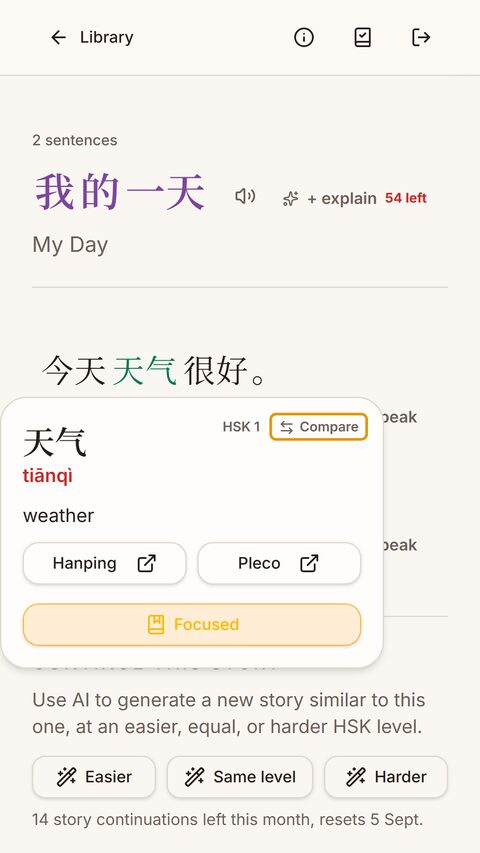
Linguists call it comprehensible input: language you're exposed to that you can mostly understand, with just a bit that's new. That "just a bit new" part is where the actual learning happens — your brain fills the gap from context, and the word or pattern sticks far better than it would from a bare definition on a flashcard. This is roughly how you learned your first language, and it turns out to still be the most reliable way to learn a second one. The catch is finding text that's actually at that sweet spot instead of miles above your head.
The other half is simply volume. Grammar and vocabulary don't become automatic because you understood an explanation once — they become automatic because you've met them in context dozens of times. A textbook chapter gives you a handful of example sentences. Reading gives you hundreds, for free, as a side effect of doing something you're already trying to do: read a story you're interested in.
Seeing a pattern like 是…的 or 把 used correctly, over and over, in context, builds an instinct for it that a grammar rule alone never quite does.
A word you met inside a story you cared about is a word you remember. A word you saw once on an isolated flashcard is a word you'll look up again next week.
Textbook Chinese and real Chinese don't always sound the same. Reading enough of it teaches you which phrasing actually sounds native.
A vocab list is homework. A story you're actually curious about is something you want to open again tomorrow — and showing up daily is most of what makes any method work.
News, novels, and native content are written for native speakers — open one at HSK 3 and you're decoding, not reading.
A fixed set of leveled texts is great for a week. Then you've read all of them and you're back to searching.
Switching to a separate dictionary app for every third word kills the immersion that made reading useful in the first place.
Generate a fresh story on any topic at your HSK level, on demand, instead of rationing a fixed library of graded readers.
Every word and sentence is tappable for pinyin and translation, right where you're reading — no context switch, no lost momentum.
Mark a word as focused and it reappears in later texts on its own — the repetition reading needs, without a separate flashcard deck.
When a pattern doesn't click just from context, ask HanRead to explain the grammar of that exact sentence in plain English.
Not entirely on its own, but it should be the backbone of your studying. Reading a lot of comprehensible text is how you turn vocabulary and grammar you've studied into language you actually recognize on sight, so pair it with whatever else you're doing — a textbook, a class, speaking practice.
As close to HSK 1 as you can stand. The goal is text you understand almost all of, with just enough new words to stretch you — not text you have to decode word by word.
This page is about the method: why reading a lot of level-matched text works. The HSK reading practice page covers the specific tool HanRead gives you to do it, level by level.
No. Tap any word for its pinyin and meaning, and tap a sentence for a full translation, so you can start reading before you can reliably decode characters on your own.